Aural Tools

Trifoglio

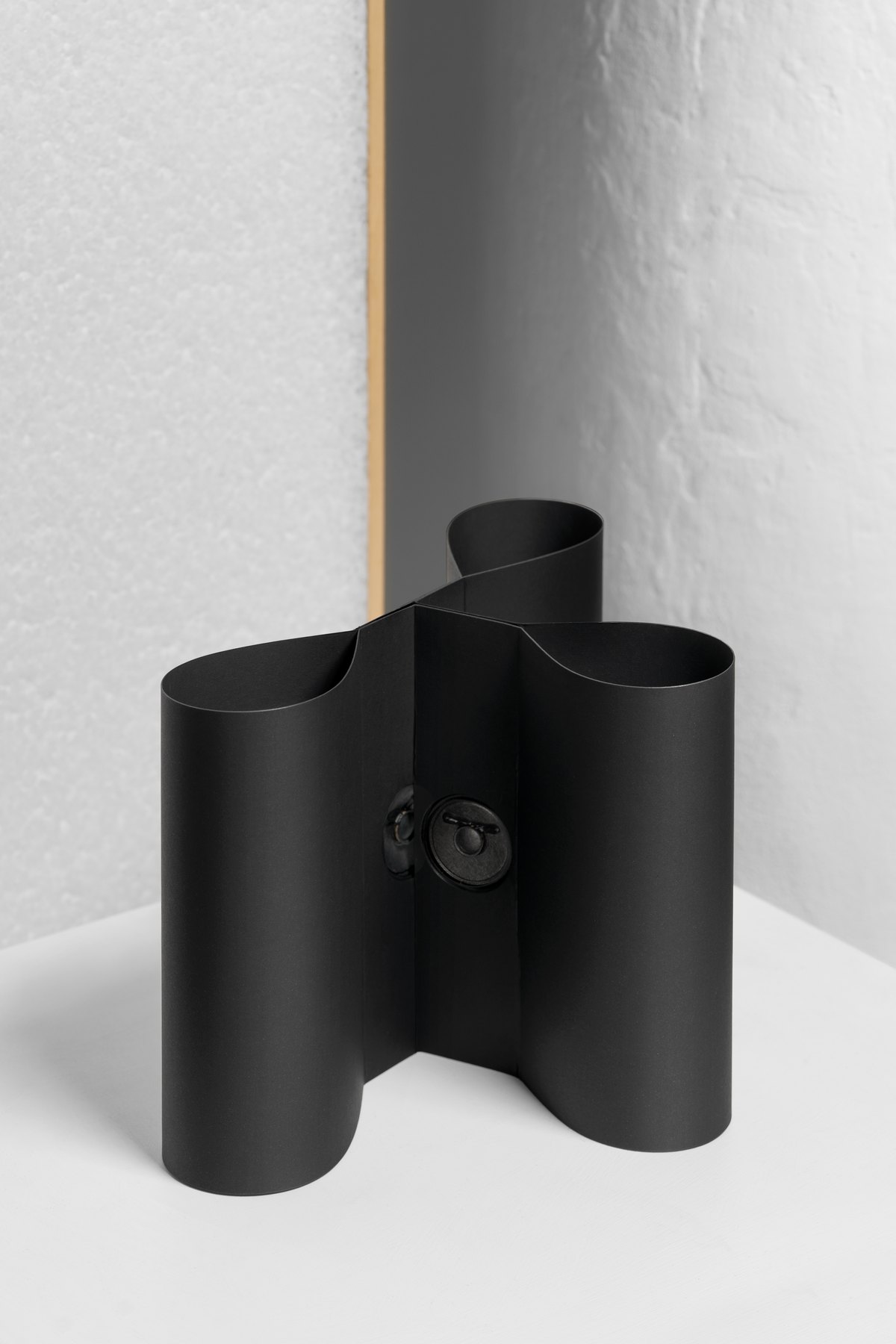
Trifoglio, black portable stereo speaker with open cones.
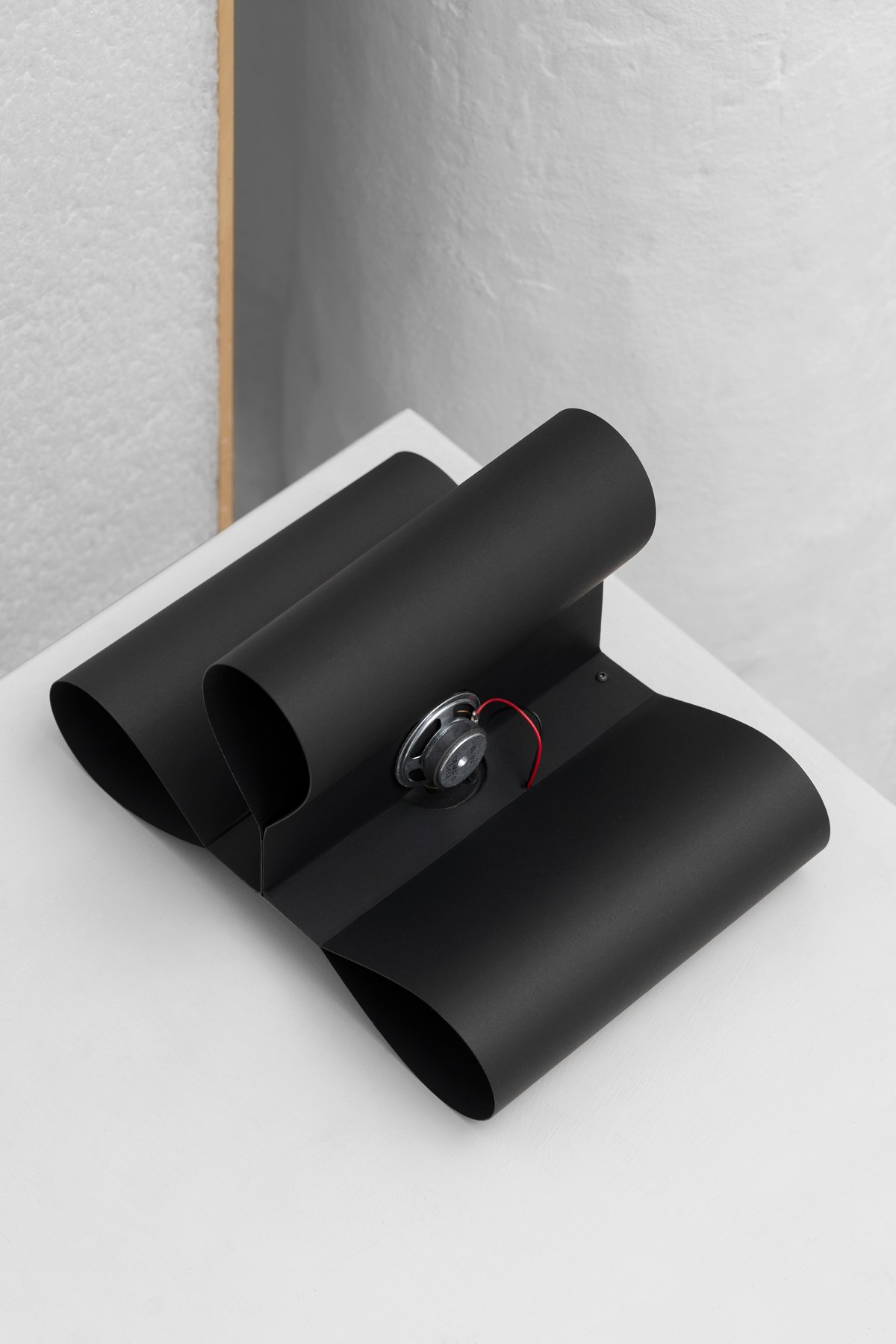
Trifoglio, detail of the black folded speaker structure and exposed driver.

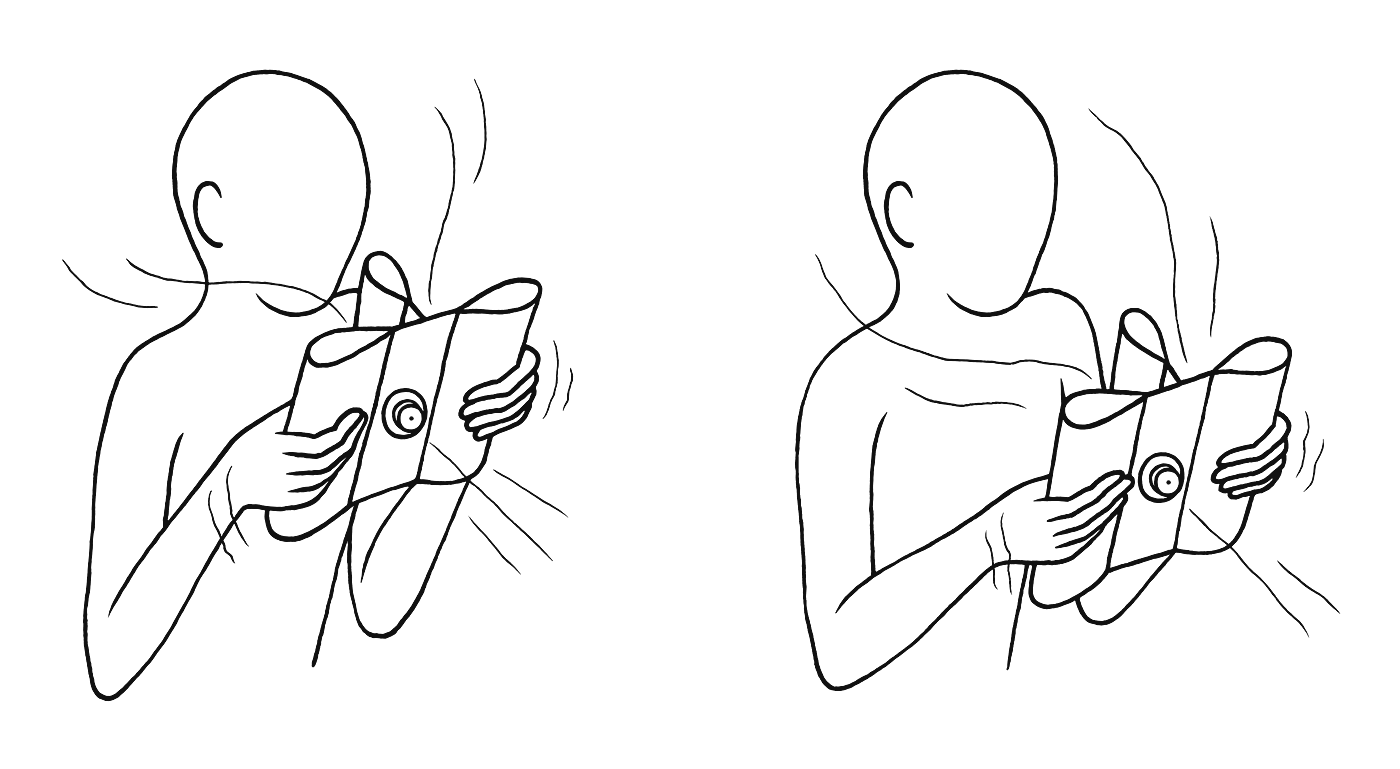
Trifoglio is a handheld stereo loudspeaker made from die-cut cardboard and simple existing electronic components. Two open speaker cones, set at right angles within a curved structure, are held in front of the face like a book. The spatial image is often ambiguous: sounds may seem to come from behind, from far away, or from somewhere between the ears.

Trifoglio is meant for music composed, assembled or remixed specifically for it by different musicians. The pieces are available online through a QR code and a link included with the object.

Read moreClose
Trifoglio started from a disappointment. I had just come back from my first professional field recording job, a commission to wander around Chicago collecting sounds for an experimental film. On site, everything felt very immersive: wind off the lake, cars, trains, birds; a raised drawbridge slowly closing, revealing the sun, then a train crossing and birds suddenly taking flight. Back home, played through ordinary loudspeakers, the recordings conveyed little of it. Only later did I understand how much of that experience I had confused with what the microphones were picking up.

At the time, though, I took it for a technical problem and naively looked for a solution in The Loudspeaker Design Cookbook by Vance Dickason. One of its most basic facts caught my attention: a loudspeaker driver produces the same sound at its front and back, but in opposite polarity, and the box keeps the two sides from cancelling each other out. I began taking drivers out of their boxes and holding them edge-on in front of my face, each ear facing one side. It was not a more faithful reproduction, but its spatial ambiguity interested me, and I could feel the vibrations through my hands.

Trifoglio condenses these experiments: two drivers without a box, arranged as a mid-side loudspeaker in a single sheet of die-cut cardboard, about a metre long and folded in three. Hence the name: trifoglio is Italian for clover. Its curved shape directs the sound towards the face and is comfortable to hold. The result is far from realistic, but it often has a strong physical presence, and unlike headphones it does not isolate the listener from their surroundings.

I had imagined releasing it with my own sound works, but musician friends who tried the early prototypes wanted to compose for it. Their pieces have gradually turned Trifoglio into something closer to a space with peculiar acoustics, which artists are invited to spend time in.

Drawing by Mattia Pajè from the instructions of Trifoglio: a person holding the folded cardboard speaker against the body.

Original sound contributions by Ryoko Akama & Gerard Lebik, Adam Asnan, Andrea Belfi, Lea Bertucci, Kai Brophy, Massimo Carozzi, Francesco Cavaliere, Choi Joonyong, Stephen Cornford, Daniele De Santis, Attila Faravelli, Fia Fiell, Marco Fusinato, Andy Guhl, Irena & Vojtech Havlovi, Giuseppe Ielasi, Takahiro Kawaguchi, Giovanni Lami, Dario Lozano-Thornton, Luciano Maggiore, Enrico Malatesta, Felicity Mangan, Carlo Mazza Galanti, Francisco Meirino, Mem 1, Seijiro Murayama, Nobile, Noid, Ottaven, Fabio Perletta, Primorje, Nicola Ratti, Glauco Salvo, Matija Schellander, Fabio Selvafiorita, Rok Šturm & Juan López, Massimiliano Viel, Ben Vince, Simon Whetham, Zorka Wollny. New contributions are added over time.

Comes with printed sheets containing an introductory text, instructions with drawings by Mattia Pajè and a QR code to the music.

One of the batches was produced during a research residency at Pianpicollo Selvatico, with the support of Fondazione Cassa di Risparmio di Cuneo and Regione Piemonte.