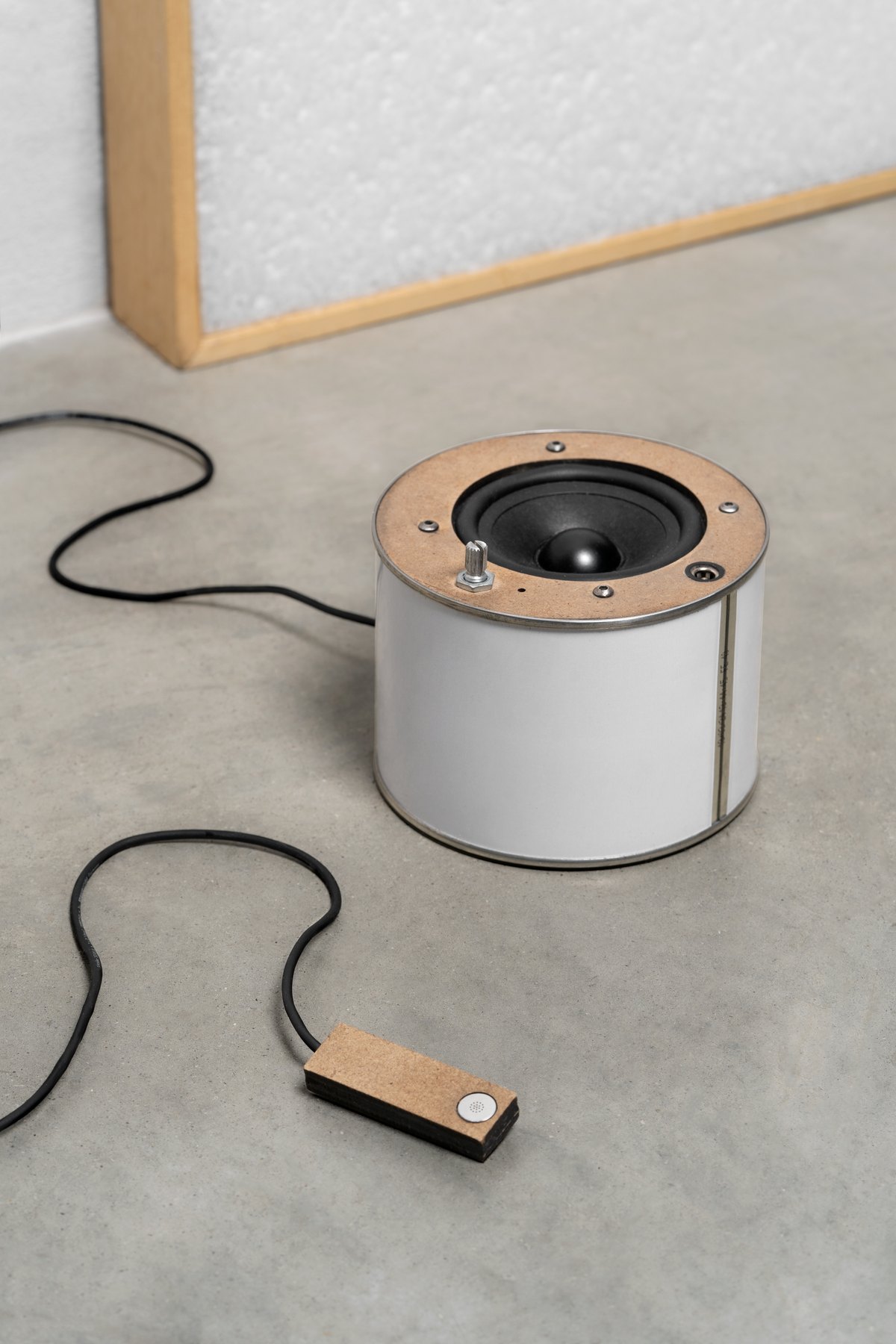
Apparecchio began with a request from Ryoko Akama. In her performances, she uses ordinary hearing aids to create feedback in bottles, glasses and other containers: the empty volume of the vessel tunes it and gives it colour. She asked whether I would like to make an object through which others could explore this directly.
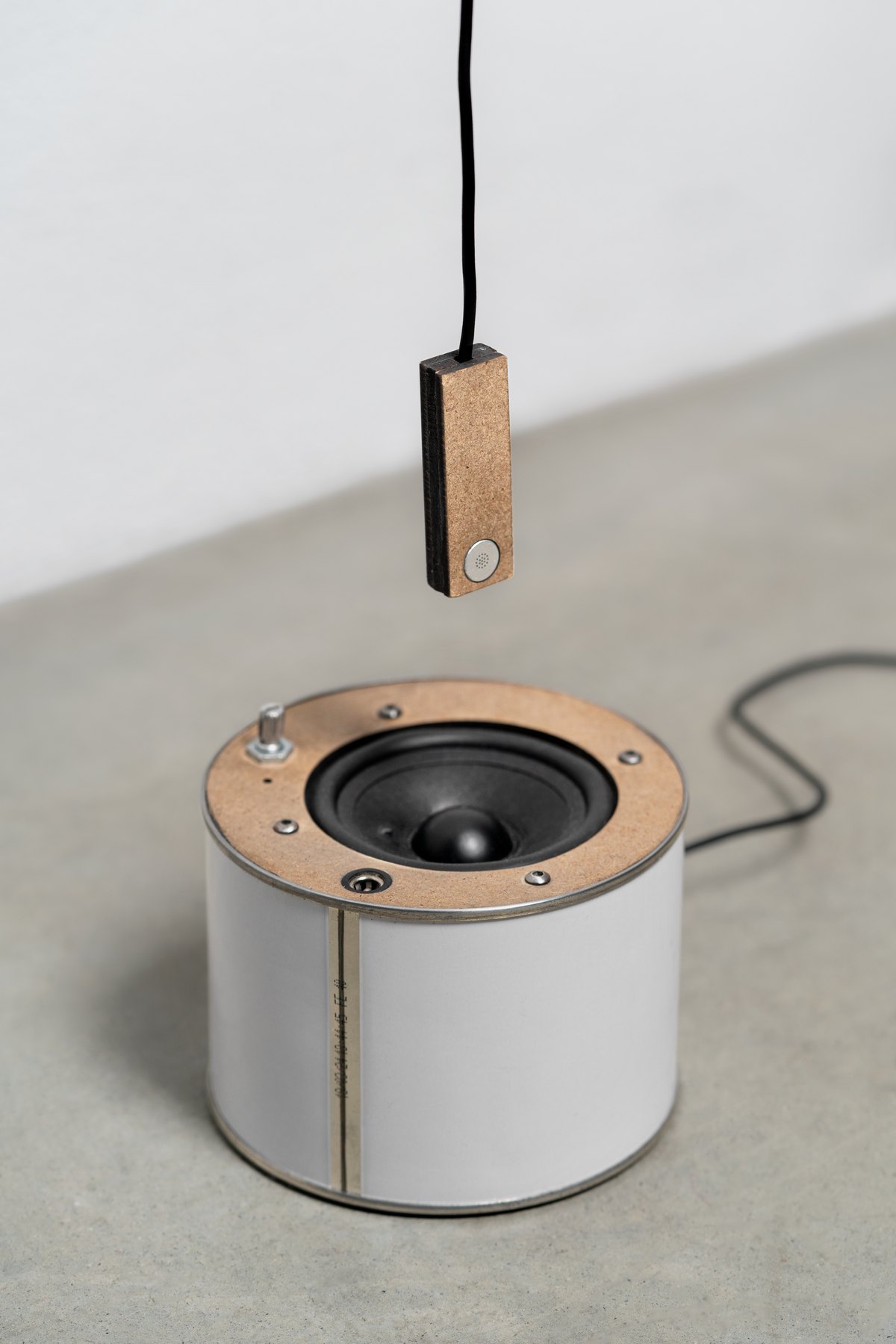
My first prototypes copied the hearing aid quite literally, and it took a lot of practice to get anything more than screeches out of them. I wanted a wider range of sounds to be available even without Ryoko’s experience, so I used a larger loudspeaker and a small microphone that goes inside the bottle, reversing her arrangement. The feedback became fuller and more textured, and I lengthened the cable so that the two could be set far apart.
In its larger form, Apparecchio also came closer to an idea Dafne Vicente-Sandoval had suggested years earlier. Dafne works with feedback using miniature microphones placed inside her bassoon. At some festivals she also filled the breaks between concerts by playing the audience’s own chatter back to them, amplified live and kept on the verge of howling: never too present, just enough to feel slightly unsettling. Her proposal was a loudspeaker that could play both its microphone and recorded music, with a cable long enough to cross an apartment from wall to wall. In the end no built-in playback was needed: a phone or a radio placed near the microphone feeds its music into the loop.
Separating microphone and loudspeaker feels a bit like field recording: the source of a sound seems to shift to the loudspeaker. The microphone is small enough to go where our heads cannot, lowered out of a window or into a drain. During one test, it picked up a fly in the studio: the amplified buzz seemed to hover in one spot, while the real fly kept moving around.
Curator Maria Paola Zedda saw a resonance between Aural Tools and Anselmo’s work, and invited us to collaborate during a residency, just as I was working on this object. Anselmo’s research traces the links between deafness, hearing aids and early sound technologies, and their normalising role in pushing deaf people towards speech and away from sign language. The title also came from Anselmo: in Italian, apparecchio is an old-fashioned word for any device, still used colloquially for a hearing aid. In Apparecchio, the architecture of the hearing aid is enlarged, pulled apart and used for play and exploration rather than to bring hearing towards a norm.