Aural Tools

Bilia

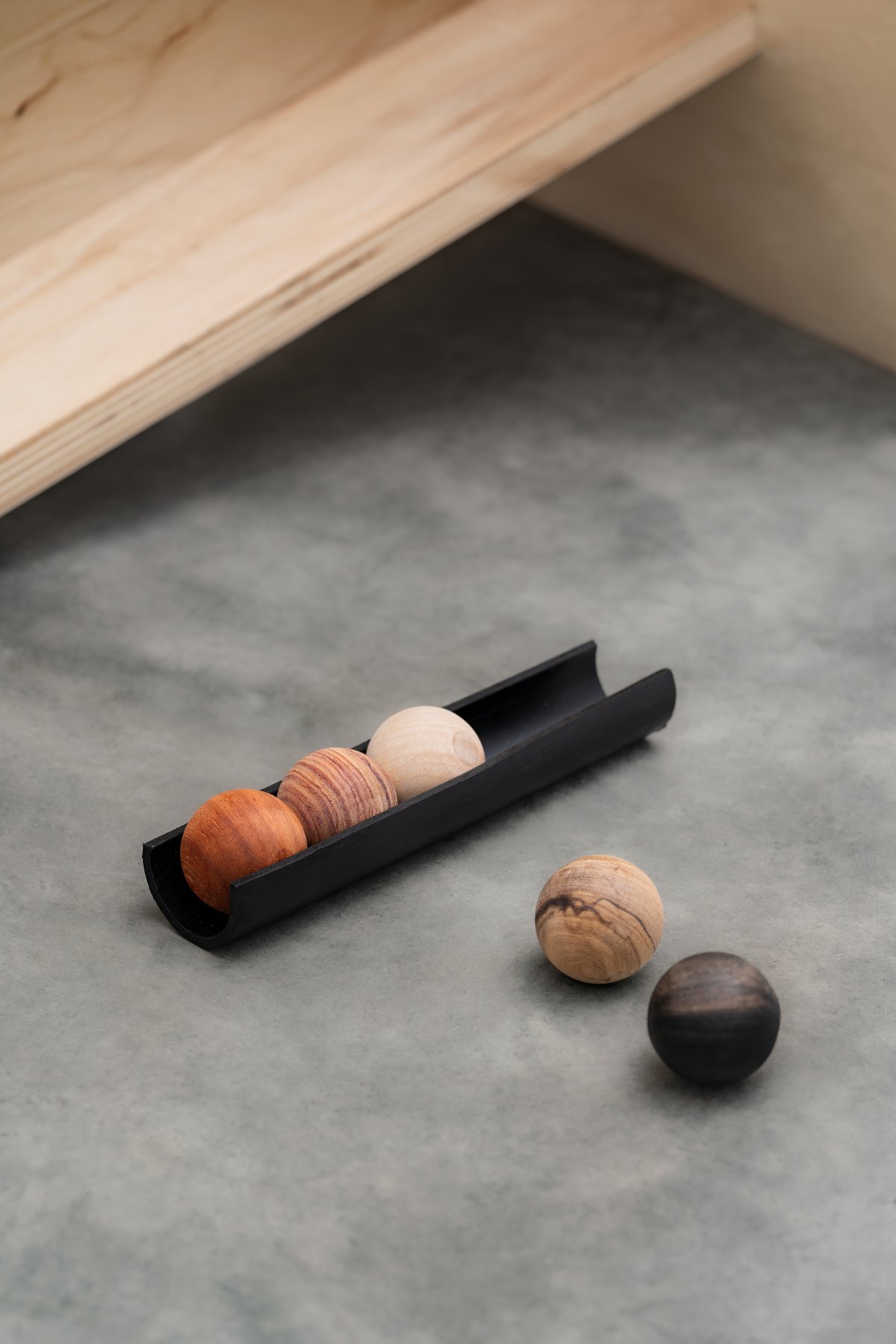
Bilia, five wooden spheres with different grains and colours.
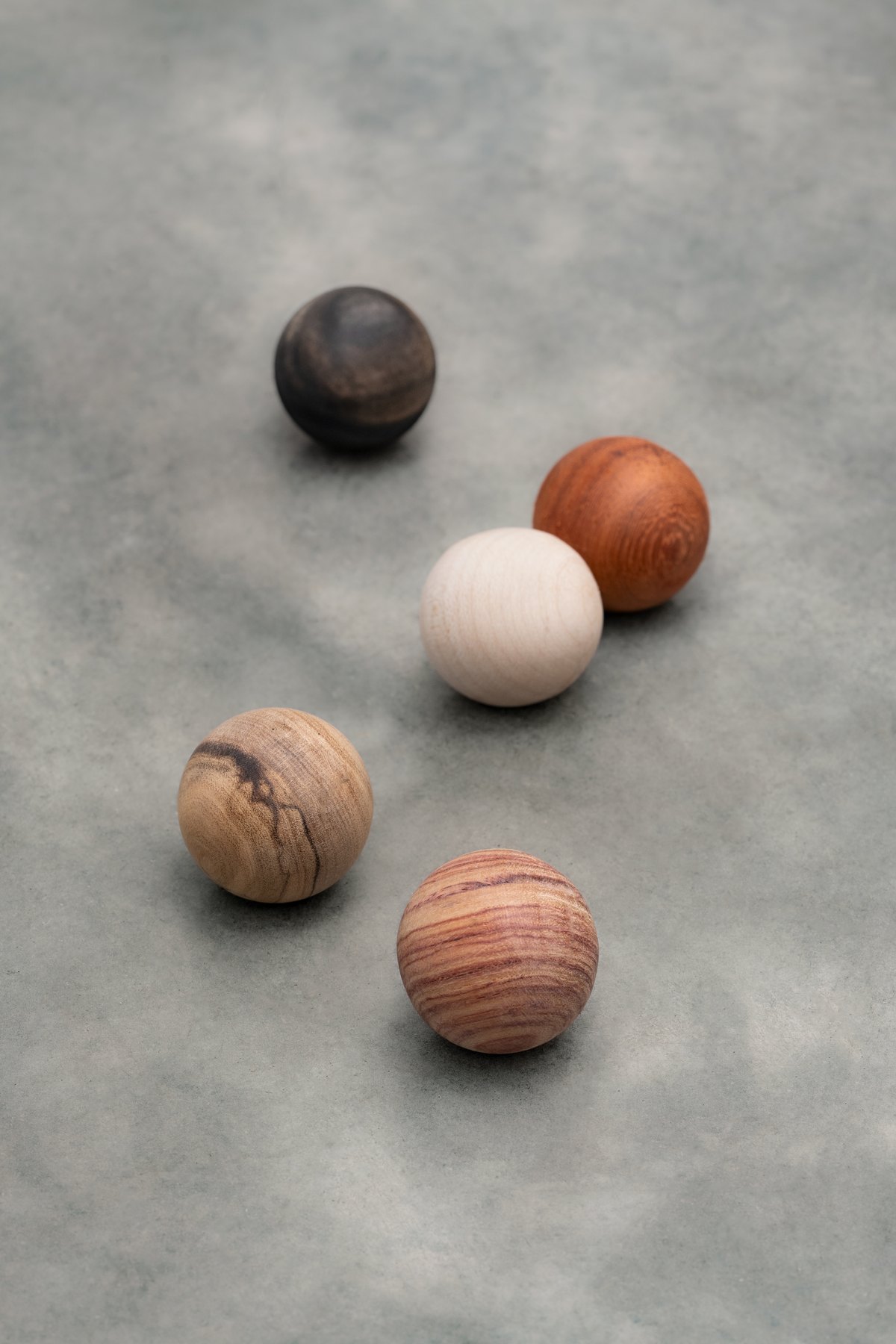
Bilia, the five wooden spheres arranged on a grey surface.

Bilia is a set of five balls, 3.5 cm in diameter, each made from a different wood. It comes from the practice of percussionist Enrico Malatesta. Rolled across a table, a floor or any other surface, the balls make audible the small irregularities they meet: grain, cracks, changes in level, wear. Each wood responds in its own way, and so does each surface.

Read moreClose

We tend to associate percussion with a vertical movement: a stick or a hand striking the instrument from above. Enrico often works horizontally instead, rubbing and sliding across it in circular, continuous gestures. This brings out the evenness of a surface, but also its breaks, what he calls its accidental properties and material imperfections, which he integrates creatively into his playing. While thinking about how to condense his approach into a simple, playful object, I realised that a rolling ball does something similar.

For Enrico, an instrument is “not just a sound producing tool but also a listening tool”. He imagines every drum skin coated with a kind of “rhythmic dust”, always there, though its distribution changes with time, weather and use. Seen this way, the balls are mainly a means of creating the conditions for listening to a space, rather than of producing specific, intentional sounds.

At first, all this talk of rhythmic dust sounded a little esoteric to me, and I wanted to check it in a more down-to-earth way. I improvised a macro setup by attaching an extra lens to a digital camera, and photographed everyday surfaces: the underside of a chair, a wooden floor, a metal utility cabinet outdoors. A coat of paint that looked uniform revealed scratches, chips and further layers underneath, hard to see but immediately audible when a ball rolled across them.

Erika Balsom’s essay The Reality-Based Community has become a reference for the whole series. Writing about documentary film, she calls for renewed attention to what observation can offer, while accepting that every point of view is partial: “the appearances of the world need our care more than our suspicion”. In our conversation, Enrico makes a related point: listening to a surface as a way of taking care of what is already there.

Comes with printed sheets containing an introductory text, instructions with drawings by Mattia Pajè and a transcribed conversation with Enrico Malatesta about surfaces, gesture and listening.

With thanks to wood expert Luciano Molinari.

One of the batches was produced during a research residency at Pianpicollo Selvatico, with the support of Fondazione Cassa di Risparmio di Cuneo and Regione Piemonte.